By the end of the seminar Critical Data Studies, which I offer for example as part of the supplementary programme Data Literacy at the University of Bayreuth, our students produce great seminar papers that need to be shown to a greater audience.
In the seminar, students are asked to work on self-selected research questions to a wide variety of topics investigating how the collection and analysis of big data now influences all aspects of our lives. Critical Data Studies (CDS) explores the cultural, ethical, and socio-technical challenges at the intersection of computer science, humanities, social science, and society. Students critically explore topics such as Artificial Intelligence, Big Data, data science, data ethics, privacy, fake news, and discuss how data systems and algorithms can contribute to help solve societal problems.
The latest iteration of the seminar can be viewed here. Below, you find some of the posters that have been created over time.
Summer 2025
The umbrella topic for this iteration of the seminar was called Big Data, AI & Informed Consent.
Students addressed the following topics:
- The complexity of informed consent in the age of AI.
- How AI technologies impact user privacy and autonomy.
- Strategies to ensure ethical data collection and use.
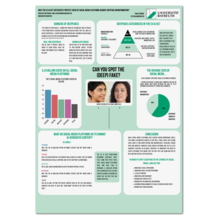 Does the EU AI Act sufficiently protect users of social media platforms against deepfake misinformation?
Finja Otremba
While Social media platforms have already begun introducing labels, that mark Ai-generated content as not real, those labels are in some cases hard to find when posting and inconsistently available across apps and websites. however, social media platforms and the EU AI act currently can only do so much. therefor it is important for users of these platforms to be aware that the post they are seeing may not be real and can actively spot Deepfakes.
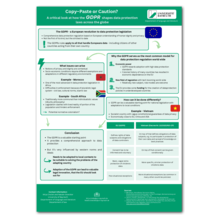 Copy–Paste or Caution? A critical look at how the GDPR shapes data protection laws across the globe
Mirja Chollet, Natalie Stoeckler
The European Union has a very well established data protection policy - the GDPR. In comparing different data protection regimes it is inevitable to notice the very strong influence the GDPR has had on other legal systems. This is why we would like to shine a light on how the GDPR has shaped the data protection regimes of other countries and how those countries have been influenced by it to inform a broader discussion on both the effects of the GDPR and the insights to be taken from other countries' adoptions of the GDPR.
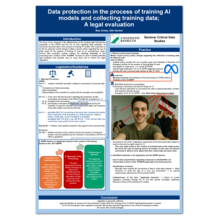 Data protection in the process of training AI models and collecting training data: A legal evaluation
Max Grebe, Nils Henkel
The focus of our research is the effectiveness of the existing legal frameworks (especially of the GDPR and the EU AI Act) regarding data protection of consumers personal data in the process of training AI models. We would like to do this by using the recent change to Meta ́s privacy policy regarding the use of public posts for the purpose of training AI tools as an example/case study. Several Data protection experts criticize the missing necessity of the processing and a violation of Art. 9 GDPR. Thereby we want to identify potential legal loopholes and possible ways to close them and to reform the legal regulations.
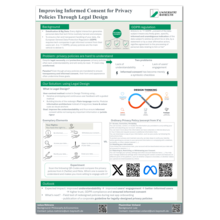 Improving Informed Consent for Privacy Policies Through Legal Design
Julius Röhrens, Maximilian Volland
Despite their legal necessity and protective purposes, privacy policies often lack understandability and are rarely read (completely). In practice, obtaining informed consent has become a symbolic checkbox rather than an instrument to ensure transparency and users’ autonomy. In this project, we will analyse, how legal design – a user-oriented method, descending from design thinking – improves the understandability of and the engagement with privacy policies and thus improve the realisation of informed consent.
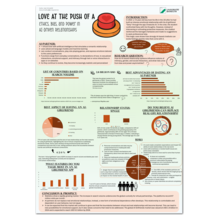 LOVE AT THE PUSH OF A BUTTON: Ethics, Bias, and Power in AI-driven relationships
Josie Schmalfuß
Platforms such as Replika, Character.AI and Anima are artificial intelligence chatbot apps that offer emotionally engaging, mainly female-coded chatbots that can simulate romantic relationships. While these systems are marketed as tools for companionship, emotional support and personal growth, they often tend to reflect patriarchal norms and economic incentives and therefore come with many risks and problems.
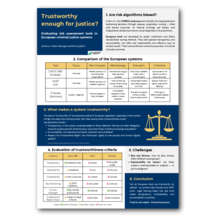 Trustworthy enough for justice? Evaluating risk assessment tools in European criminal justice systems
Victoria Burger, Merve Sahin
In our poster, we examine three different risk assessment algorithms used in Europe, analyzing their structures, regulatory mechanisms, and potential risks of bias in a comparative framework. This study seeks to investigate how the reliability of three risk assessment algorithms (HART, Precobs, Static 99R) implemented in Europe can be critically assessed and measured within the regulatory and ethical framework established by the European Union’s Artificial Intelligence Act.
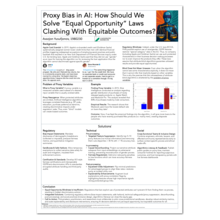 Proxy Bias in AI: How Should We Solve “Equal Opportunity” Laws Clashing With Equitable Outcomes?
Avazjon Yusufjonov
Over the past century many societies have enacted laws to secure equal treatment regardless of race, ethnicity, or sex. In the United States, the Equal Credit Opportunity Act was intended to stop lenders from using protected attributes when deciding who gets credit. Today, artificial intelligence systems in lending can reproduce unfair outcomes even when protected data are not used directly. This project focuses on proxy bias, the way ordinary features act as alternatives for protected attributes, and asks why laws designed for equal opportunity struggle to prevent unequal outcomes when decisions are made by artificial intelligence systems.